
Compliance Corner
January 28, 2026
January 28, 2026
This month’s Compliance Corner outlines several regulatory updates affecting licensing, onboarding, and cybersecurity reporting across multiple jurisdictions.
Below is a summary of the most relevant changes and upcoming deadlines to support near-term planning and ongoing compliance operations.
Updates include appointment renewal deadlines, changes to state licensing portals, termination and reporting obligations, fingerprinting and application sequencing, and new cybersecurity notification requirements.
Upcoming Appointment Renewal Reminders:
Wyoming:
Invoices mailed: February 1, 2026
Appointments retroactively expire: January 31, 2026
Payment deadline: March 31, 2026
Non-payment results in termination effective: January 31, 2026
North Dakota:
Termination request deadline: February 20, 2026
Renewal invoices available: March 2, 2026 (via NIPR)
Payment deadline: April 30, 2026
No grace period
District of Columbia:
Termination deadline: February 24, 2026
North Carolina:
Termination deadline: January 24, 2026
Invoices available: February 3, 2026 (via NIPR)
Payment due: March 31, 2026
Grace period through May 14, 2026
The Michigan Department of Insurance and Financial Services (DIFS) Announces a New License Renewal Feature for Adjusters
MI License for Resident and Non-Resident Adjusters (independent and public) to pay $5 before license expires on March 31st. Renewals not paid by March 31 will result in cancellation of the license. Reinstatements are allowed within 12 months of cancellation.
A new enhancement to its Licensing Express Renewal web portal that will make renewing licenses easier for all licensees using their 7-digit Michigan System ID number and paying the license renewal fee(s).
Users can now renew multiple licenses in a single transaction with the new cart feature that will be available beginning February 1.
This upgrade is designed to streamline the renewal and payment process for individuals and entities that manage a large number of licenses. The renewal portal will be available from February 1 through March 31, 2026.
License will reflect the renewal the next business day, and a new license will automatically generate and be mailed to the address on file. Licensees can view their updated license on the DIFS website using the insurance agent locator.
Maryland Reminder of Process for Termination For Cause Appointments
Maryland’s insurance Administration issued a bulletin that reminds insurers to notify the Commissioner of the termination when the producer has engaged or is engaging in activities related, but not limited to:
- Misrepresentation or concealing material facts
- Committed fraudulent or dishonest practices
- Selling insurance without an actual intent to sell insurance
- Convicted of final judgement in any state or federal court of a felony or crime involving moral turpitude
- Knowingly writing or issuing over-insurance of property insurance risks
- Has failed or refused to pay on demand money that belongs to the insurer, insurance producer, or other person entitled to money
- Has transacted insurance business without proper licensing
Terminations for cause can be completed on their online form, and uploading supporting documents or email enforcement.mia@maryland.gov
Washington Demographic Changes Transition to NIPR
As of January 21st, all core licensing transations for individuals and business entity name and address changes must be completed through NIPR.
Nevada Changes Fingerprinting Requirement
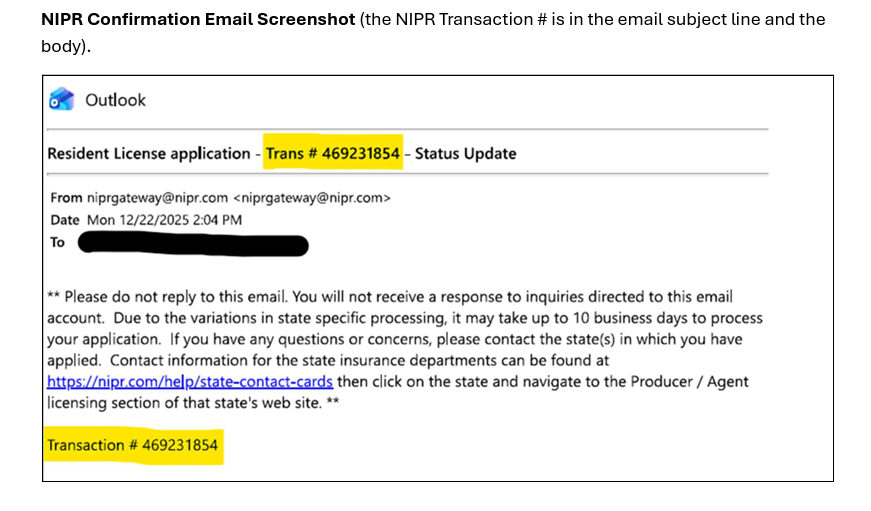
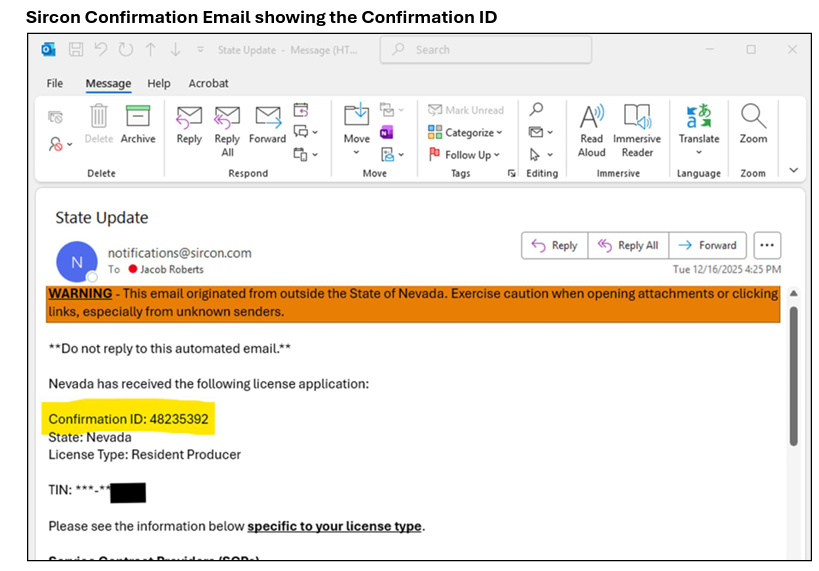
Effective January 26th, Nevada will begin requiring applications to provide their Sircon Confirmation ID or NIPR transaction number on the Fingerprinting Authorization Form. These numbers can ONLY be obtain AFTER submitting a license application. If an applicant goes to a fingerprinting vendor and this number is left blank, they will NOT be allowed to be fingerprinted. Applicants will receive emails like the samples below with their Sircon or NIPR transaction number:
Missouri enacted an Insurance Data Security Act
Effective January 1st, the Department requires a licensee to notify the Director that a cybersecurity event has occurred when specific requirements are met. The electronic form can be accessed https://apps.dci.mo.gov/forms/CybersecurityEventNotification. All Cyber events should be reported using this form. Violations of this act will be penalties up to $1M per each violation, injunctions, and asset freezes, to name a few.
According to the Statute a cybersecurity event is defined:
(3) “Cybersecurity event”, an event resulting in unauthorized access to, malicious disruption of, or misuse of an information system or nonpublic information in the possession, custody, or control of a licensee or an authorized person; however:
- The term “cybersecurity event” does not include the unauthorized acquisition of encrypted, nonpublic information if the encryption, process, or key is not also acquired, released, or used without authorization; and
- The term “cybersecurity event” does not include an event with regard to which the licensee has determined that the nonpublic information accessed by an unauthorized person has not been used or released and has been returned or destroyed;
Nonpublic information is:
(12) “Nonpublic information”, information that is not publicly available information and is:
- Business-related information of a licensee, the tampering with which, or unauthorized disclosure, access, or use of which, would cause a material adverse impact to the business, operations, or security of the licensee;
- Any information concerning a consumer that, because of name, number, personal mark, or other identifier, can be used to identify such consumer, in combination with any one or more of the following data elements:
- Social Security number;
- Driver’s license number or nondriver identification card number;
- Financial account number or credit or debit card number;
- Any security code, access code, or password that would permit access to a consumer’s financial account;
- Biometric records; or
- Military identification number;
- Any information or data, except age or gender, in any form or medium created by or derived from a health care provider or a consumer and that relates to:
- The past, present, or future physical, mental, or behavioral health or condition of any consumer or a member of the consumer’s family;
- The provision of health care to any consumer; or
- Payment for the provision of health care to any consumer;
Any questions can be emailed to cyberbreach@insurance.mo.gov
We’ll continue monitoring these changes as additional guidance is released and state systems adjust. If any of these updates affect your licensing, compliance, or operational workflows, it’s worth validating timelines and controls now, especially where requirements phase in through 2026.
Questions about how these updates affect your licensing or compliance workflows?
We can help you assess what applies, what’s changing, and where to focus first.

With more than 25 years in the insurance industry, Wendy Boe specializes in enterprise risk management, corporate governance, and legal & compliance operations. Her career spans roles as a direct-writing agent, independent agency owner, and compliance consultant for adjusting firms, MGAs, and alternative insurance markets. She is passionate about mentorship and education, has taught CE and pre-licensing programs, and is currently pursuing a Juris Doctorate. Wendy holds CIC, FCLS, and CRM designations.